




Connect the refrigerator to a suitable, ready backup supply as soon as practical if the outage may outlast its safe cold hold time. Do not treat four hours as a target to wait before switching on: it is an approximate window for an unopened refrigerator, and actual food safety depends on temperature and time. Keep the door closed, use an appliance thermometer, and reserve enough energy for the refrigerator's measured cycling load and compressor start.
Key Takeaways
- FoodSafety.gov says an unopened refrigerator keeps food cold for about four hours; a full closed freezer for about 48 hours, or 24 hours when half full.
- Keep the refrigerator at or below 40°F (4°C) and the freezer at or below 0°F (−18°C). Track temperature rather than relying on smell.
- Backup power can maintain cooling only while the appliance actually runs. It cannot make food safe again after an unsafe warm period.
- Measure the fridge's energy use and starting demand before choosing a power station.
Start with the first minutes of an outage
Note the time power stopped. Leave refrigerator and freezer doors closed. Check that the power station is charged and located on a dry, stable, ventilated surface. Have a thermometer in each appliance before an emergency, because a reading after the outage is more useful than guessing from how cold a package feels. FoodSafety.gov's emergency guidance gives the approximately four-hour refrigerator and 48/24-hour freezer references, assuming doors stay shut.
The October 10, 2026 storm-related outages in Riverside County are a reminder that a food-loss event can occur even when the power cut is local. The USDA California disaster notice describes a time-limited SNAP reporting waiver for that event; it is not a general food-safety rule or an ongoing benefit. Use the food-safety guidance above for decisions at home.
When should you connect the refrigerator?
If a safe backup is available and the outage could extend beyond a few hours, connecting early protects more margin than waiting for the four-hour reference to expire. If backup energy is scarce, first protect immediate health and communication needs, then weigh the food at risk, thermometer reading, coolers and ice available, and likely recharge opportunity. The four-hour reference assumes an unopened appliance; frequent door opening, a warm kitchen, or food already above its target temperature changes the situation.
Make a written handoff: outage start time, time the refrigerator was connected, any later interruption, and the thermometer reading. A refrigerator may cycle rather than draw its rated running watts continuously. Do not repeatedly restart it merely to save energy if the appliance maker advises against that pattern.
Use temperature and time to decide what to keep
FoodSafety.gov advises discarding perishable food that has been above 40°F (4°C) for two hours or more, or one hour when ambient temperature exceeds 90°F (32°C). Food touched by floodwater or stormwater should be discarded. Do not taste food to test safety. Frozen food may be refrozen or cooked if it still has ice crystals or is at or below 40°F (4°C); assess each package and follow the official chart for specific foods.
When a safe temperature history cannot be established, take the conservative food-safety route. The capacity of a power station does not reset the clock on food that warmed before it was connected.
Size backup energy from the fridge's actual load
Measure watt-hours over a representative day with a compatible meter, or start with the appliance's energy label and check the result in use. For a demonstration only, suppose a fridge averages 75W over an eight-hour period. It uses 75W × 8h = 600Wh. If 80% of a station's nominal capacity reaches the appliance after usable-capacity and conversion losses, the nominal capacity needed is 600Wh ÷ 0.80 = 750Wh. The 80% factor is an illustrative assumption, not an OUPES efficiency claim. Kitchen temperature, door openings and defrost cycles change the average.
Separately verify that the refrigerator's voltage, plug, running watts and compressor-start demand fit the power station's continuous, surge and individual outlet limits. A large Wh figure alone cannot prove that a compressor will start.
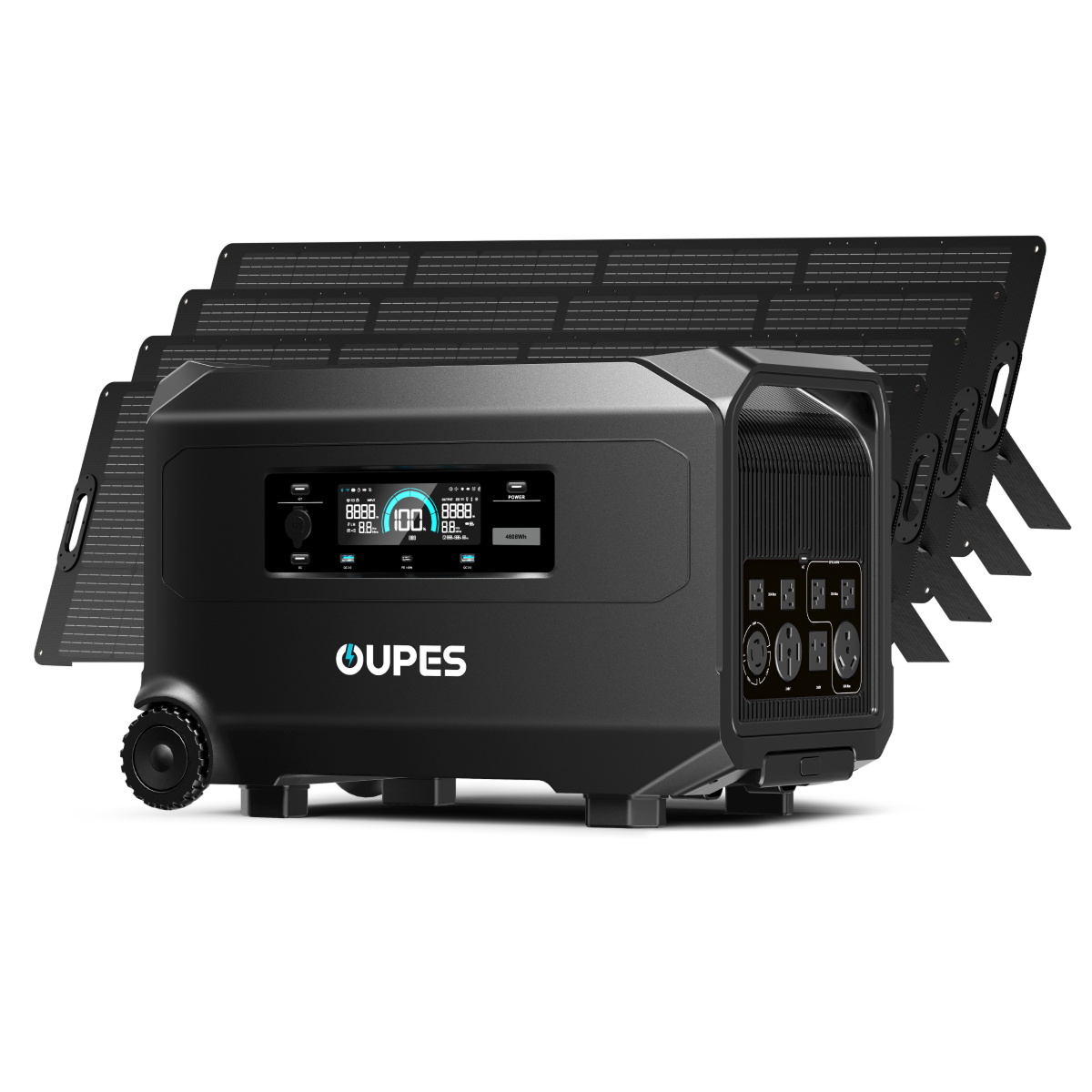
For a household that also wants substantial margin for lighting and communication, the OUPES Mega 3 is a US-market example with 3,072Wh nominal capacity and 3,600W rated AC output. These are product specifications, not a guaranteed refrigerator runtime. Measure the actual fridge and confirm its startup requirements before selecting any configuration.

OUPES Mega 3
- 3,072Wh nominal capacity.
- 3,600W rated AC output; check each outlet and startup load.
- Budget runtime from measured appliance energy.
Connect safely and plan for depleted backup
Use a sound appliance cord directly with a compatible power-station outlet, within both manuals' limits. Keep the station dry and ventilated. Never feed its outlet into a wall receptacle or improvise a home transfer connection. For long outages, decide in advance where to obtain ice, a cooler, or safe shelf-stable meals if the battery cannot be recharged.
Keep the freezer closed too. Its longer cold hold time is useful but depends on fullness and an unopened door. Label food and record temperatures if you need to move it to another cold location.
Frequently Asked Questions
Should I wait four hours before turning the fridge back on?
No. Four hours is an approximate unopened-fridge cold hold reference. If you have appropriate backup and an uncertain restoration time, starting earlier gives more temperature margin.
Does a cold-feeling carton prove food is safe?
No. Use appliance or food temperature and the time history. Appearance, odor and touch cannot reliably establish safety.
Will a power station preserve food after it warms above 40°F?
It can resume cooling, but it cannot reverse an unsafe exposure. Apply the official discard guidance.
Is a freezer the same as a refrigerator for this plan?
No. The approximate closed-door hold periods differ, and both need temperature monitoring. Size backup for the appliances you actually intend to run.



Leave a comment
This site is protected by hCaptcha and the hCaptcha Privacy Policy and Terms of Service apply.