




A whole-house solar generator cannot be selected from peak watts alone. Begin by deciding whether “whole house” means every circuit, a professionally selected critical-load panel, or a portable plan for individual appliances. Then calculate simultaneous running watts, motor startup demand, outage watt-hours, charging conditions, and the electrical equipment required for safe integration.
A high-output portable solar generator can support substantial household loads, but it should not automatically be described as an installed, automatic, grid-interactive whole-home system. Fixed connections, transfer equipment, grounding, permits, and utility requirements are installation-specific and require qualified professional assessment.
Define What “Whole House” Means
Homeowners use “whole house” in different ways. One person may want refrigeration, a furnace blower, lights, internet, and a well pump. Another may expect central air conditioning, an electric range, water heating, laundry, and every ordinary outlet to work without scheduling. Those plans can differ by many kilowatts and kilowatt-hours.
Choose one planning scope:
- Individual-load backup: compatible appliances plug into the power station through approved methods.
- Critical-circuit backup: selected household circuits are served through professionally designed transfer and distribution equipment.
- Broad whole-home backup: a designed system supports a larger share of household demand and may require automated load management, greater storage, and more charging capacity.
The U.S. Department of Energy notes that residential solar panels alone generally are not enough to keep a home operating during a grid failure; outage operation requires appropriate inverter configuration and storage. Its Solar and Resilience Basics guidance explains why solar, storage, and system configuration must be considered together.
Build a Critical-Load Inventory
Walk through the home and record each load that may be needed during an outage. Use nameplates, manuals, manufacturer documentation, or qualified measurements. Do not rely on a generic home-wattage chart for installation decisions.
| Priority | Possible household loads | Planning information |
|---|---|---|
| Critical | Medical equipment, communications, safety systems | Required continuity, manufacturer guidance, reserve |
| Essential | Refrigerator, freezer, furnace controls, well or sump pump | Running watts, startup demand, cycling energy |
| Scheduled | Microwave, coffee maker, selected tools, laundry | Input watts and planned operating window |
| Optional | Entertainment and high-energy comfort loads | Can be paused to protect battery reserve |
Medical devices and safety systems need their own manufacturer-approved backup plan. Heating, pumping, and fixed appliances may have connection or grounding requirements beyond their wattage. A load belongs on the list only after its electrical requirements and safe connection path are known.
Calculate Running and Startup Power
Add the running watts of equipment that could operate simultaneously. Then identify the largest startup event. Refrigerators, pumps, furnace blowers, air conditioners, and compressors may briefly need more power when starting. The backup source must support that event while carrying other active loads.
Suppose critical and essential loads total 2,100W while operating. A well pump then starts, creating an additional temporary demand. A system selected only because its continuous rating is slightly above 2,100W may not handle the combined event. The exact startup value must come from reliable equipment data or measurement.
Load scheduling can reduce required simultaneous output. A household can pause cooking equipment while a pump runs, delay laundry, or avoid starting multiple compressor loads together. This approach should be written down and understood by everyone who may operate the system during an outage.
Rated output is not energy capacity. A 6,000W inverter describes supported power, while a 4,608Wh battery describes stored energy. A system can have sufficient output to start a device yet insufficient energy to run the household for the intended time.
Size Battery Capacity for the Outage
Calculate each load's energy:
Energy in Wh = average watts × operating hours
Imagine that refrigeration and communications use 1,500Wh over a planning period, heating or pumping controls use 2,000Wh, lighting and electronics use 600Wh, and scheduled appliances add 700Wh. The subtotal is 4,800Wh before conversion losses, temperature effects, uncertainty, and reserve.
With an illustrative 85% planning efficiency, covering 4,800Wh would require about 5,647Wh of nameplate capacity before adding further reserve. This is a method example, not a household prediction. Device cycling, inverter overhead, battery condition, temperature, and changing behavior affect actual results.
Duration matters as much as the daily total. Multiply the budget for each day that must be covered without dependable recharge. If solar is expected to recover part of the battery, create a poor-weather case as well as a favorable case. Critical medical or safety loads need a separate contingency rather than dependence on one optimistic calculation.
Plan Solar Recovery and Load Management
Solar panel wattage is not guaranteed continuous production. Sun angle, season, weather, shade, temperature, panel position, cable losses, and the system's charging limits influence actual input. Compare expected daily solar watt-hours with daily household consumption, not just panel watts with inverter watts.
Use strong sunlight to recharge the battery and run scheduled loads when practical. Preserve overnight capacity for refrigeration, communications, heating controls, and other essentials. During cloudy periods, reduce discretionary loads early instead of waiting for a low-battery warning.
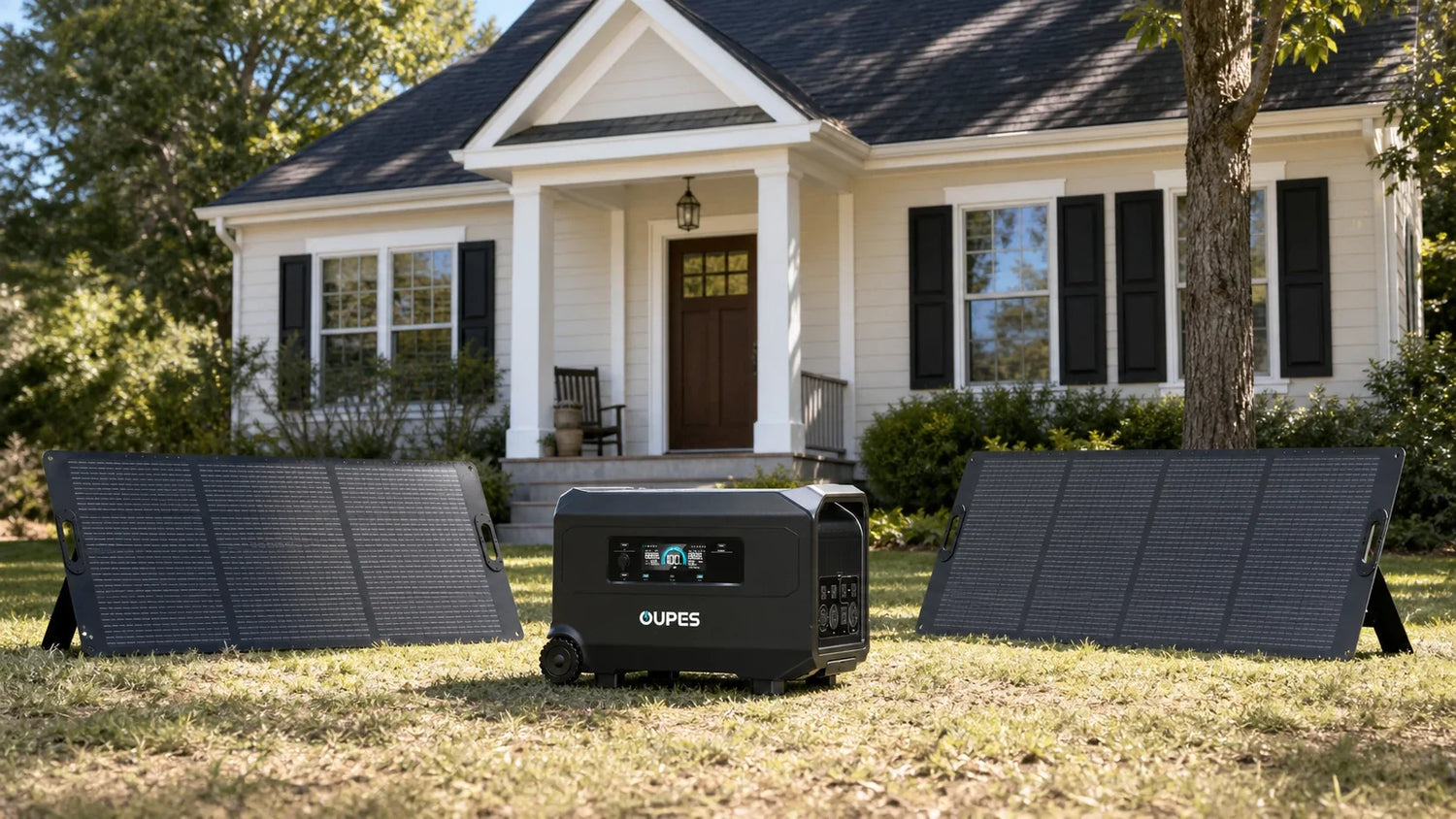
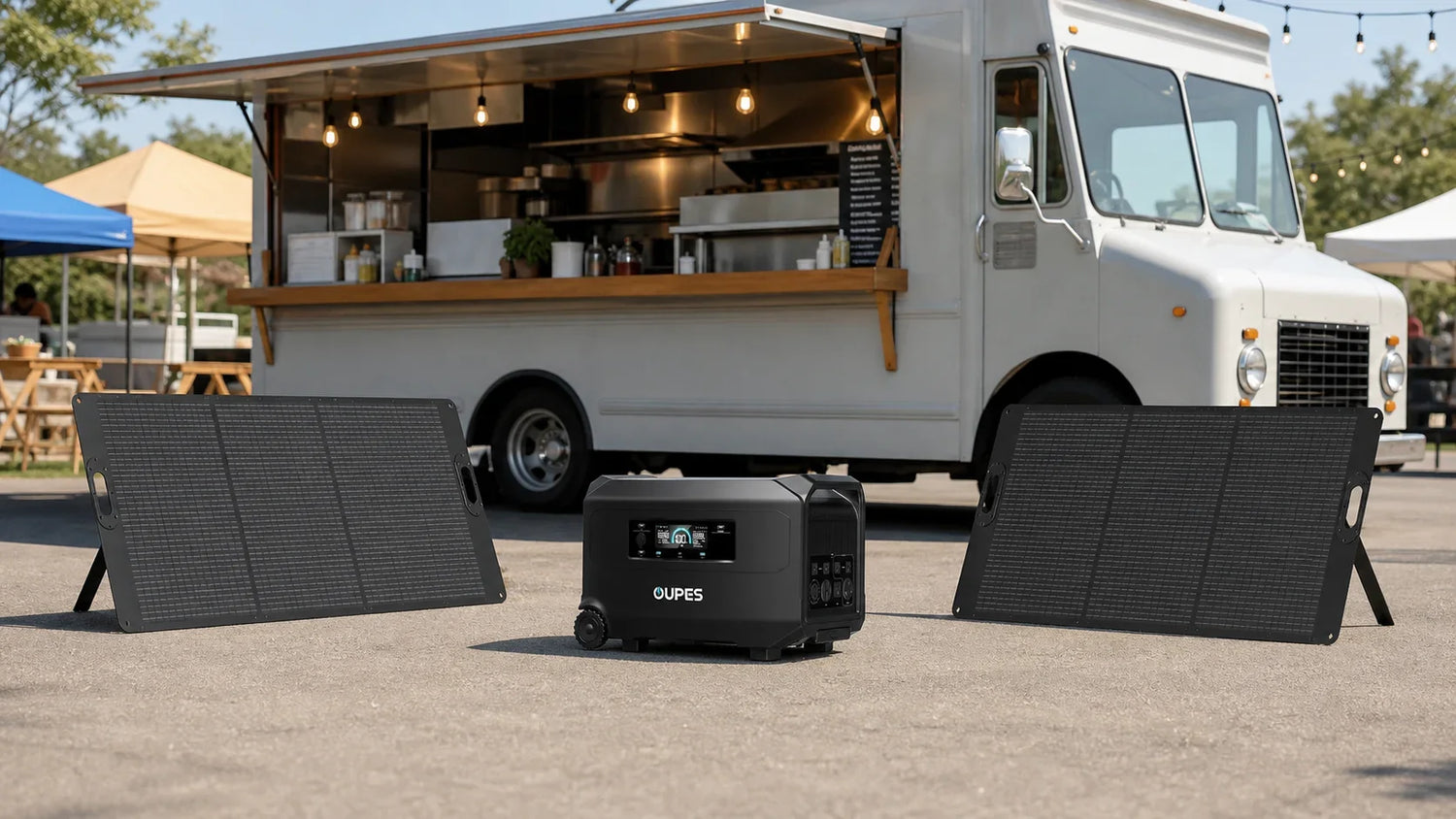
Also distinguish included panel power from maximum solar input. The Guardian kit discussed below includes two 240W panels, for 480W of panel nameplate power. The main unit's 3,600W solar-input specification is a supported maximum, not the output of the bundled panels. Actual collection from the two panels will vary with conditions.
Storage makes solar energy available after generation, but the complete system must be configured for outage use. The Department of Energy's Solar Energy Guide for Homebuilders notes that grid connection involves panel labeling, breaker placement, utility interconnection, local authorities, building codes, and additional electrical requirements for storage. Those considerations are why this article does not provide DIY integration instructions.
Separate Portable Backup From Fixed Integration
A portable or wheeled solar generator can supply compatible plug-in loads without becoming part of the home's permanent wiring. A Home Backup Power bundle may add an expansion battery for longer duration. Neither product category should be assumed to provide automatic circuit transfer, utility interconnection, or universal whole-home compatibility.
Never backfeed a household outlet or use a male-to-male cord to energize home wiring. The U.S. Consumer Product Safety Commission warns that this practice can create electrocution and fire hazards in its warning on hazardous male-to-male extension cords.
Any fixed connection should be designed and installed by qualified professionals who evaluate the home's service, transfer equipment, circuit selection, grounding, neutral configuration, permits, codes, inspections, utility rules, and product instructions. Local requirements vary. The professional design—not the product's marketing category—determines how the system may be integrated.
Compare Two Guardian 6000 V2 Bundles
The US product table lists two Guardian 6000 V2 bundles relevant to high-power backup planning:
| Bundle | Composition | Capacity | Rated output | Solar specification |
|---|---|---|---|---|
| Guardian 6000 V2 Solar Generator Kit | Main unit ×1; 240W panels ×2 | 4,608Wh | 6,000W | 480W included panels; up to 3,600W main-unit input |
| Guardian 6000 V2 Home Backup | Main unit ×1; G5 expansion battery ×1 | 9,216Wh | 6,000W | Up to 3,600W main-unit input; no panel listed in kit |
The Solar Generator kit emphasizes bundled solar collection with two panels and 4,608Wh of capacity. It can suit a household that values a ready panel bundle and whose calculated energy needs fit the capacity and realistic recovery plan. The Home Backup bundle doubles listed capacity to 9,216Wh by adding a G5 expansion battery, making it more suitable for a longer energy budget when charging equipment is planned separately.
Both list 6,000W rated output, but that does not guarantee operation of every appliance or the entire house. Startup behavior, voltage, connection requirements, simultaneous demand, energy duration, and professional integration still determine suitability. Neither bundle should be described as an automatic whole-home installation without the required additional design and equipment.
Whole-House Planning Checklist
- Define whether the goal is individual loads, critical circuits, or broad whole-home coverage.
- Record verified running watts, startup demand, voltage, and operating hours.
- Calculate watt-hours for the target outage and retain reserve.
- Create favorable- and poor-solar recovery cases.
- Confirm kit composition, included panels, expansion batteries, and input limits.
- Identify storage, ventilation, temperature, moisture, and cable-routing requirements.
- Obtain professional review for transfer equipment and every fixed connection.
- Confirm applicable codes, permits, inspections, utility rules, and manufacturer instructions.
- Test the approved setup and document household load priorities.
Frequently Asked Questions
Can a 6000W solar generator power an entire house?
It may support a substantial calculated load, but 6,000W alone does not guarantee whole-house operation. Add simultaneous running demand, verify motor startup events, calculate watt-hours, and confirm connection requirements. Electric heating, cooling, water heating, cooking, pumps, and other large loads can change the result.
How many watt-hours does whole-home backup need?
Multiply each priority load's average watts by operating hours, total the energy, then include conversion losses, uncertainty, temperature effects, and reserve. The result depends on selected circuits and duration. A critical-load plan can require far less capacity than operating every normal household appliance.
Will solar panels work during a power outage?
Panels alone do not automatically provide usable household backup when the grid fails. The system requires suitable inverter configuration, storage, controls, and safe electrical design. A portable solar generator is a different configuration from a grid-connected rooftop array, so follow the instructions and integration rules for the actual system.
Do I need a transfer switch?
If backup power will serve fixed household circuits, suitable transfer and distribution equipment may be required. The exact design depends on the home, product, local code, utility, and authority having jurisdiction. Have a qualified professional determine and install the appropriate equipment; never improvise backfeeding.
Is more battery capacity better than more solar panels?
They solve different constraints. Battery capacity supports loads when generation is unavailable, while panel capacity affects potential recovery in suitable sunlight. The right balance comes from the daily energy budget, outage duration, realistic solar conditions, charging limits, available panel space, and desired reserve.
What is the difference between a Solar Generator and Home Backup bundle?
In this product table, the Solar Generator bundle includes a main unit and solar panels, while the Home Backup bundle includes a main unit and an expansion battery. Exact contents vary by listing. Neither label by itself establishes fixed electrical integration or automatic whole-home operation.
Conclusion
Whole-house solar generator planning begins with loads and duration, not a single output number. Define the backup scope, verify running and startup power, calculate watt-hours, model realistic solar recovery, and distinguish portable equipment from a professionally integrated system. The result may be a focused critical-load plan, a larger expandable battery plan, or a designed whole-home installation—but it should never depend on improvised wiring or an unverified “powers everything” claim.
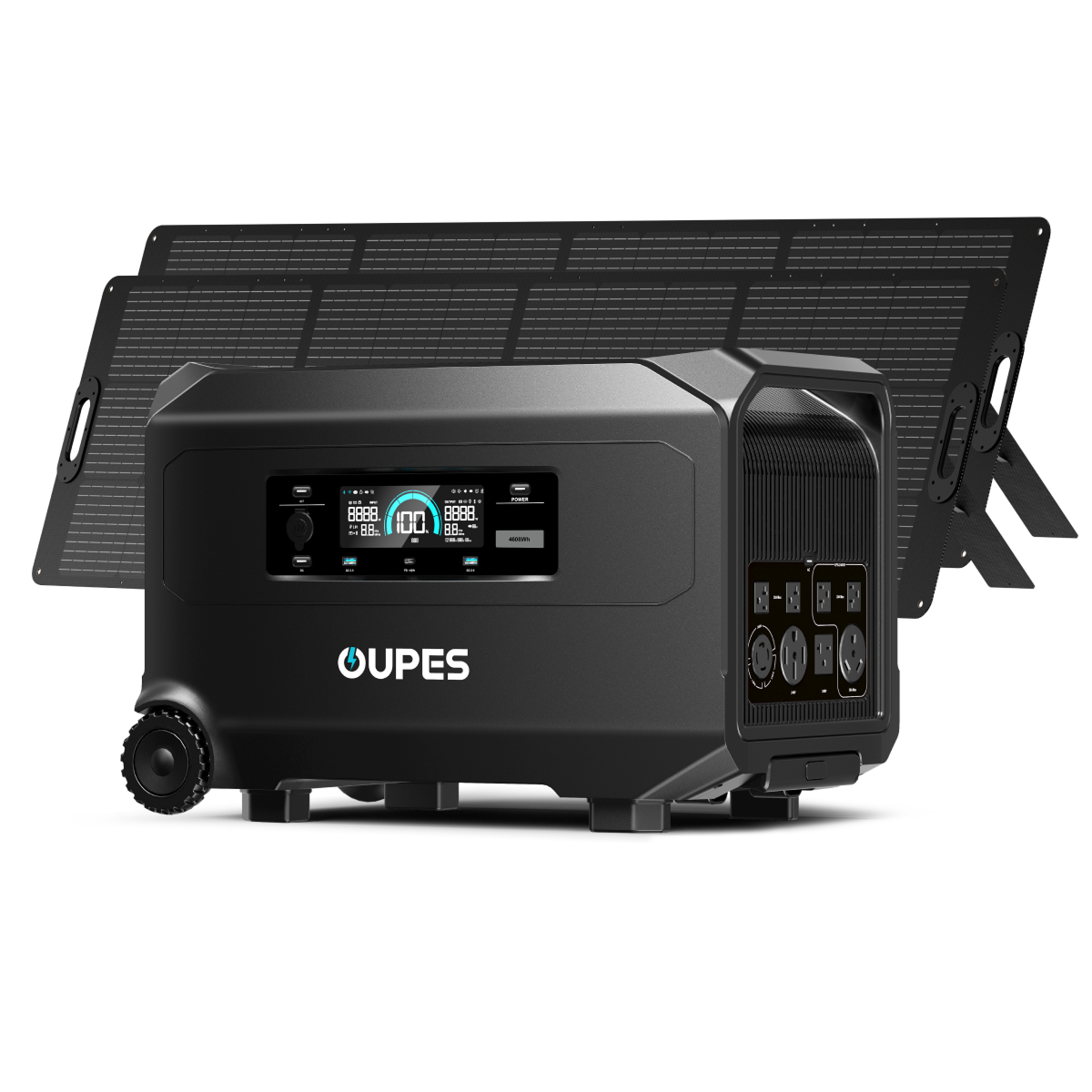
Guardian 6000 V2 + 2×240W Solar Panel Solar Generator Kit
- Guardian 6000 V2 main unit plus two 240W solar panels
- 4,608Wh battery capacity for calculated backup loads
- 6,000W rated output for compatible high-power equipment
- Up to 3,600W solar input supported by the main unit


Leave a comment
This site is protected by hCaptcha and the hCaptcha Privacy Policy and Terms of Service apply.