




Yes, a sufficiently large solar generator can charge an electric vehicle when its AC output, voltage, outlet, grounding behavior and continuous rating are compatible with the vehicle's charging equipment. In most portable setups, the result is an emergency or supplemental range top-up rather than a full EV charge. The battery capacity of the solar generator determines how many miles may be added, while solar input determines how quickly that stored energy can be replenished.
Key Takeaways
- The EV is charged through compatible EV supply equipment (EVSE), not by connecting a loose cable directly to a battery station.
- Level 1 charging may fit some high-output 120V stations; Level 2 requires compatible 240V output and substantially more power.
- Conversion and vehicle-charging losses make energy delivered to the EV lower than the station's rated capacity.
- A large portable station often adds only a modest number of miles.
- Never use improvised adapters or backfeed home wiring.
How the Charging Chain Works
A solar generator combines a battery power station with compatible solar panels. The panels charge the station; the station's inverter supplies AC power; the EVSE communicates with the vehicle and passes power to its onboard charger. Every stage must be compatible.
The phrase “solar charging an EV” can therefore describe two different systems. A home solar installation may charge an EV from a dedicated circuit and the grid. A portable solar generator stores a much smaller amount of energy and then supplies a portable EVSE. This article addresses the portable arrangement.
Level 1 and Level 2 Have Different Requirements
The U.S. Department of Energy's Alternative Fuels Data Center describes Level 1 as 120V charging that commonly adds about 2–5 miles of range per hour, while Level 2 uses 240V and commonly adds about 10–30 miles per hour. Actual rates depend on the vehicle, EVSE and available circuit.
| Charging type | Electrical basis | Portable-system implication |
|---|---|---|
| Level 1 | 120V EVSE, often a sustained load | Possible with a compatible station whose outlet and continuous output support the exact EVSE |
| Level 2 | 240V EVSE at higher power | Requires purpose-compatible 240V output, outlet, grounding behavior and sufficient continuous power |
A station's peak or surge rating does not qualify it for hours of EV charging. Use the continuous rating and the limit of the specific outlet.
Complete Every Electrical Compatibility Check
- Confirm EVSE input voltage, current and plug.
- Confirm station voltage, frequency, continuous inverter output and individual outlet limit.
- Verify that the EVSE's grounding and neutral checks are compatible with the station's documented output design.
- Keep the combined load below the station rating for the full session.
- Use only listed, manufacturer-supported cables and adapters.
- Protect equipment from rain, standing water, heat and cable damage.
Some EVSE units refuse to start when their safety checks do not detect the expected supply arrangement. Do not defeat those checks. Consult the EV, EVSE and power station documentation; ask the manufacturers about the exact combination when any requirement is unclear. A qualified electrician should handle building circuits and transfer equipment.
Estimate How Many Miles the Station Could Add
Use a transparent planning formula:
Added miles ≈ station kWh × station delivery factor × EV charging factor × reserve factor × vehicle miles per kWh.
For illustration, assume 85% station delivery, 90% EV charging efficiency, 20% station reserve and vehicle efficiency of 3.5 miles/kWh. Real EV efficiency varies with vehicle, speed, weather, terrain, cabin conditioning and battery temperature.
| Rated station capacity | Estimated energy reaching vehicle | Illustrative range at 3.5 mi/kWh |
|---|---|---|
| 1.024kWh | 0.63kWh | 2.2 miles |
| 3.072kWh | 1.88kWh | 6.6 miles |
| 4.608kWh | 2.82kWh | 9.9 miles |
These figures are planning examples, not guaranteed vehicle range. They show why a portable station is usually a bridge to a charger rather than a replacement for one.
Do not estimate from battery percentage alone when accuracy matters. The vehicle may reserve energy outside the displayed range, and its efficiency history can change with recent driving. Use the vehicle's actual recent miles-per-kWh figure for a better estimate, then keep enough station reserve to shut down and transport the equipment safely.
Cold weather may reduce both the station's delivered energy and the vehicle's efficiency, so a warm-weather estimate should not be treated as a winter guarantee.
Calculate the Solar Energy Needed to Replace the Charge
Solar harvest can be estimated as panel watts × equivalent peak-sun-hours × system factor. A 1,200W array with four peak-sun-hours and a 75% factor produces an illustrative 3.6kWh per favorable day. A 3,600W array under the same assumptions produces 10.8kWh, provided the station can accept the array and conditions support the estimate.
Panel voltage, current and open-circuit voltage must remain inside the station's limits. Shade on part of an array, high panel temperature, clouds and poor angle reduce harvest. Browse portable solar panels as system components, then validate the full array design against the power station manual.
For routine EV charging, a properly designed home solar and EV charging system is generally more practical than repeatedly moving a portable station. Portable equipment is most compelling for testing, remote support or a small emergency top-up where the limitations are understood.
OUPES Systems to Evaluate for EV Top-Ups
Large capacity and high output narrow the field, but neither model should be assumed compatible with every EVSE. Specifications were checked on September 22, 2026. Confirm the exact vehicle, EVSE, outlet and grounding requirements before use.

OUPES Mega 3
- 3,072Wh base capacity.
- 3,600W continuous AC output and 7,000W surge.
- Expandable up to 15.36kWh with compatible batteries.
- A high-output 120V platform to evaluate for a compatible Level 1 EVSE and modest top-up.

OUPES Guardian 6000 V2
- 4,608Wh base capacity.
- 6,000W at 240V and 3,600W at 120V, subject to outlet limits.
- Expandable from 4.6kWh to 41.4kWh.
- Dual-voltage output to evaluate for a compatible EVSE within all outlet and continuous limits.
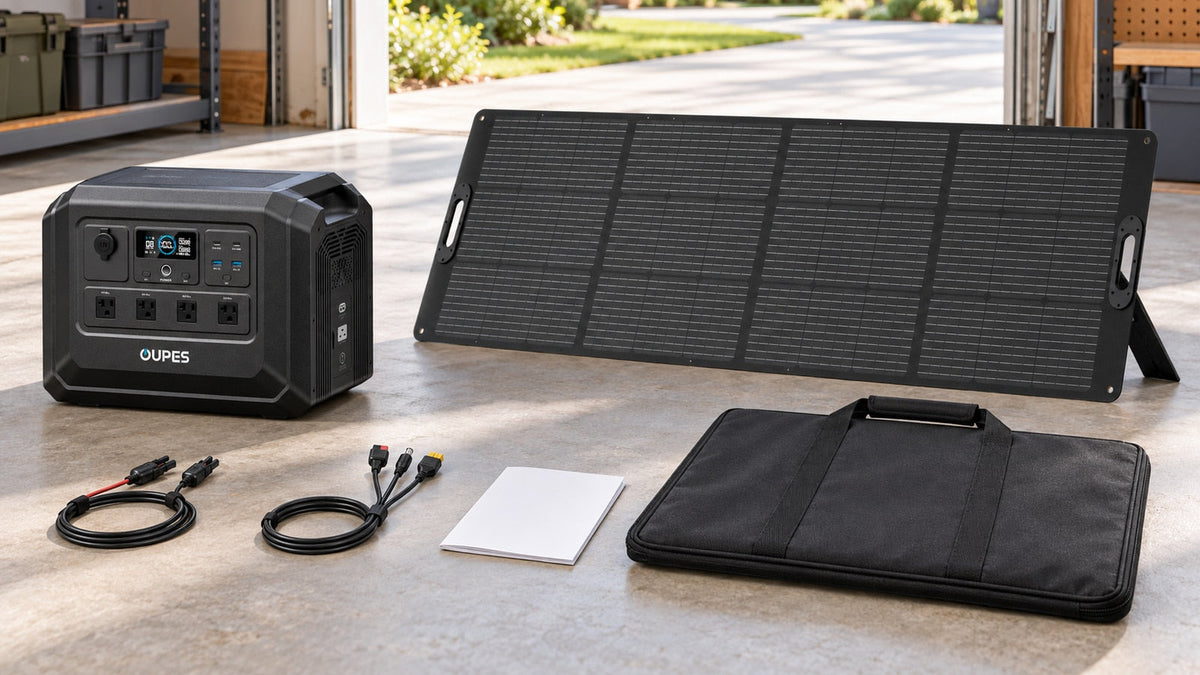
Users considering a portable battery-plus-panel system can compare the broader solar generator collection. The selected solar array must also remain within the station's input window.
Frequently Asked Questions
Can any portable power station charge an EV?
No. The station must satisfy the EVSE's voltage, continuous power, outlet and grounding requirements.
Can I plug the EV directly into the station?
Use the vehicle's compatible EVSE and supported connection. Do not improvise a direct battery connection.
How many miles can a 3kWh station add?
The example estimates about 6.6 miles after assumed losses and reserve. Your vehicle and conditions may differ materially.
Can a 120V station provide Level 1 charging?
Possibly, if the exact EVSE current and safety checks are supported for the full charging session.
Can a 240V station provide Level 2 charging?
Possibly, but only with compatible 240V output, plug, grounding behavior and continuous power. Verify the complete combination.
Why does my EVSE refuse to start?
It may detect an unsupported supply or grounding condition. Do not bypass the safety check; consult the manufacturers.
Can solar panels charge the EV while connected?
The power station may accept solar while supplying a load if its documentation supports that mode, but solar variability and input limits still apply.
How long does the top-up take?
Divide energy delivered by charging power, then allow for losses. The EVSE and vehicle may reduce the rate.
Is portable EV charging useful in an emergency?
It can add enough range to reach a nearby charger in some situations, but the available miles may be modest.
Can I connect the station to a home EV charger circuit?
Only through a system specifically designed for that purpose. Never backfeed wiring or use an unsupported adapter arrangement.

Leave a comment
This site is protected by hCaptcha and the hCaptcha Privacy Policy and Terms of Service apply.