




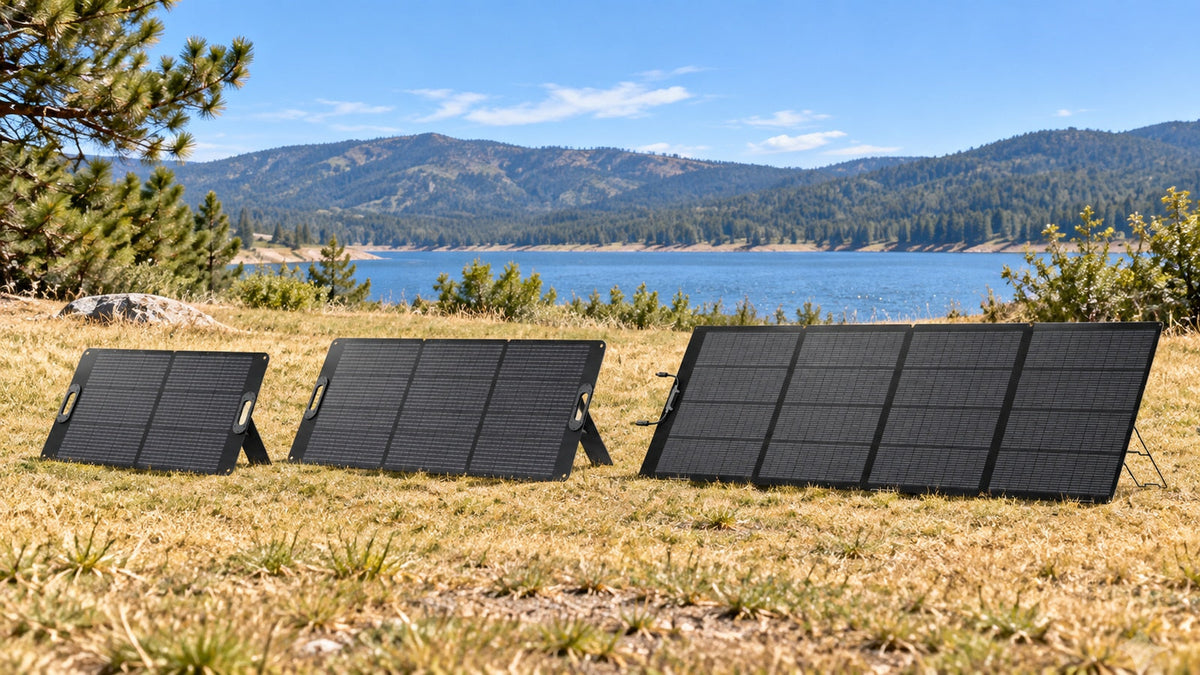
Choose a 100W portable panel when easy carrying and small daily loads matter most, a 240W panel when you want a balanced one-person setup and faster charging, and a 360W panel when higher daily harvest is worth more weight and setup space. Before buying, verify the power station's PV voltage, current and watt limits. Panel wattage alone does not establish compatibility or daily energy production.
Key Takeaways
- Daily solar energy depends on sun hours, shade, angle, temperature and system losses.
- 100W is easiest to carry; 240W balances portability and output; 360W prioritizes harvest.
- Open-circuit voltage and short-circuit current matter as much as connector fit.
- A larger panel may be clipped by the power station's input limit.
- Weather rating does not override the manufacturer's operating and rain instructions.
Estimate Daily Solar Energy Before Selecting Wattage
Use panel watts to estimate energy under stated assumptions:
Daily harvest (Wh) ≈ panel watts × equivalent peak-sun hours × system factor.
With four equivalent peak-sun hours and an illustrative 75% system factor, a 100W panel yields about 300Wh, a 240W panel about 720Wh, and a 360W panel about 1,080Wh. These are planning examples, not guaranteed daily outputs. Passing clouds, partial shade, poor angle, high cell temperature, conversion losses and the power station's input limit can lower the result.
| Panel | Calculation | Estimated harvest |
|---|---|---|
| 100W | 100 × 4 × 0.75 | 300Wh |
| 240W | 240 × 4 × 0.75 | 720Wh |
| 360W | 360 × 4 × 0.75 | 1,080Wh |
Compare harvest with daily consumption, not with battery capacity alone. If your devices use 800Wh each day, the 240W example creates an 80Wh daily deficit while the 360W example provides theoretical margin. Stored battery energy can cover a temporary deficit, but repeated deficits eventually empty the station.
Compare the Three Portable-Panel Classes
| Class | Choose it when | Main tradeoff |
|---|---|---|
| 100W | You carry the panel often, charge smaller stations or support light electronics | Slower energy replacement and less margin in weak sun |
| 240W | You want a balanced camping, RV or backup panel for medium daily loads | More folded size and weight than 100W |
| 360W | You need higher daily harvest and have vehicle or home storage for the panel | More weight, ground area and handling effort |
The best portable panel is the one you can safely transport, deploy in an unshaded location and connect within the station's limits. A 360W panel stored indoors because it is awkward at the campsite produces less energy than a 240W panel you can position well.
Verify Voltage, Current, Connector and Input Limits
Check the panel's open-circuit voltage (Voc), voltage at maximum power (Vmp), short-circuit current (Isc) and operating current (Imp). Compare them with the power station's permitted PV range and current limit. When panels are wired in series, voltage adds. In parallel, current adds. Do not change the wiring arrangement without calculating the resulting array values.
Cold conditions can increase Voc, so leave appropriate voltage margin. A station that accepts only 240W may safely accept a higher-nameplate panel in some approved configurations, but it will not necessarily use the extra power. Follow the station and panel manuals rather than assuming overpaneling is allowed.
MC4-style connectors on the panel side and XT60, Anderson or another connector at the station may require the supplied adapter cable. Connector appearance does not prove polarity or electrical suitability. Use the cable specified for the equipment.
Plan the Carry, Ground Area and Weather Response
The current OUPES specifications list the 100W panel at 12.48lb, the 240W at 18.48lb and the 360W at 24.03lb. Add cables and carrying cases when planning a hike or repeated setup. Folded dimensions matter in a vehicle; unfolded length and kickstand clearance matter at the destination.
Choose a location that stays unshaded as the sun moves. Even a small shadow across part of a folding panel can reduce output. Keep cables away from walkways, water and sharp edges, and provide airflow around the connected power station.
OUPES lists IP ratings for these panels, but the current product FAQs instruct users not to operate them in rain or extreme weather and to move and dry them if rain occurs. Follow that operating guidance. An ingress rating should not be used to invent a broader rain-use claim.
Choose Wattage by Use Case
Phone, camera and light charging
A 100W panel can be a sensible match when the daily energy total is modest and the power station accepts its voltage and current. It is also easier to reposition through the day.
Camping or RV basecamp
A 240W panel provides more daily energy without reaching the handling size of the 360W class. Review OUPES guidance for a solar generator for camping or an RV power station, then calculate the specific loads.
Home backup and higher daily use
A 360W panel can make better use of a station with higher PV input capacity, especially when time and sun are limited. Larger daily loads may still require multiple compatible panels or another charging source.
Compare Current OUPES Portable Solar Panels
Specifications below were checked on the official U.S. product pages on September 18, 2026.

OUPES 100W Portable Solar Panel
- 100W monocrystalline panel with ETFE lamination.
- Voc 24.4V; Vmp 20.5V.
- Isc 5.27A; Imp 4.88A.
- 12.48lb listed weight.

OUPES 240W Portable Solar Panel
- 240W monocrystalline panel with ETFE lamination.
- Voc 24.6V; Vmp 20.5V.
- Isc 12.3A; Imp 11.7A.
- 18.48lb listed weight.

OUPES 360W Portable Solar Panel
- 360W monocrystalline panel with ETFE lamination.
- Voc 36.0V; Vmp 30.0V.
- Isc 12.72A; Imp 12.0A.
- 24.03lb listed weight.
Compare the full OUPES portable solar panel range with your station's input label before choosing a panel or multi-panel array.
Frequently Asked Questions
Will a 240W panel charge twice as fast as a 100W panel?
Not in every condition. It has more nameplate power, but input limits, sun, angle, temperature and charging behavior determine actual speed.
Can I connect a 360W panel to a 240W solar input?
Only if the manufacturer permits the configuration and the voltage and current remain within limits. Expect clipping at the input ceiling.
Can I mix 100W and 240W panels?
Mixed electrical characteristics can reduce performance or exceed limits. Use only a wiring configuration approved for the station.
Do portable panels work through a window?
They may produce some energy, but glass, tint, angle and indoor placement can reduce output substantially. Follow product placement instructions.
How long will a panel take to charge 1kWh?
Divide required battery energy by actual input power, then allow for charging behavior and losses. Do not divide by nameplate watts unless that output is sustained.
Is IP65 or IP68 permission to leave the panel in rain?
No. Follow the current OUPES operating instructions, which say not to use these panels in rain or extreme weather.
Which size is best for one person to carry?
The 100W is lightest among these three. The right choice still depends on daily energy and how far you carry it.
Should I buy two smaller panels or one larger panel?
Two panels can offer placement flexibility, while one larger panel simplifies wiring. Compare total voltage, current, weight, setup space and input limits.
What specification should I check first?
Check the station's allowed PV voltage range, then current and watt limits. Only then compare harvest and portability.

Leave a comment
This site is protected by hCaptcha and the hCaptcha Privacy Policy and Terms of Service apply.